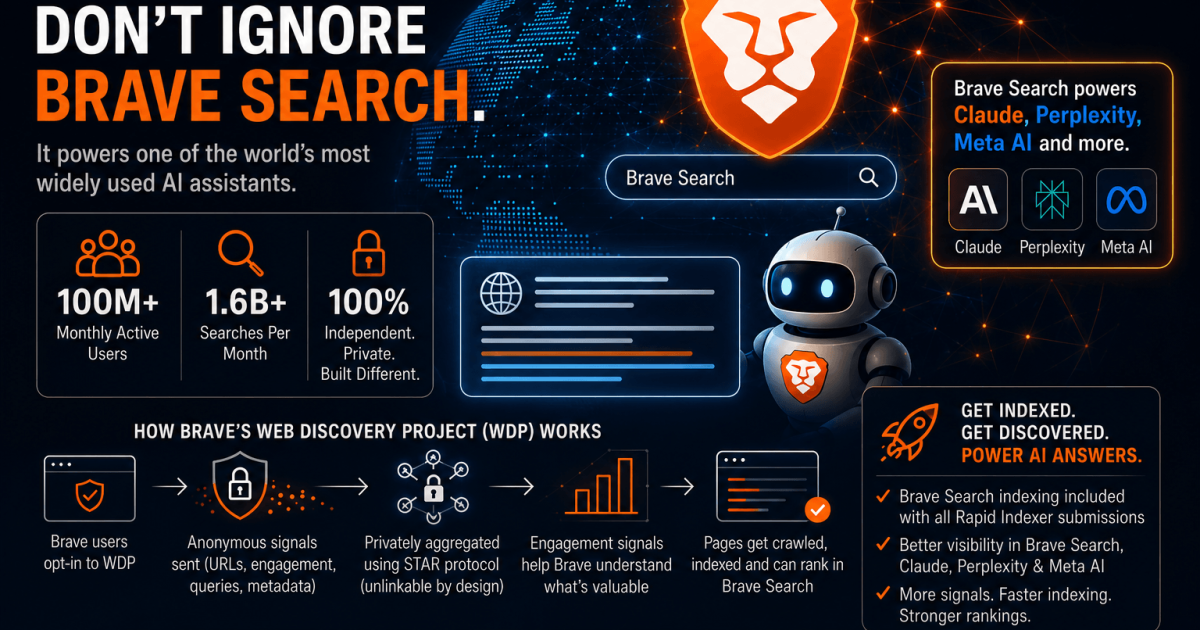
If you’re doing SEO in 2026 and ignoring Brave Search, you’re missing a channel that now directly feeds one of the world’s most widely used AI assistants. Here’s what the Web Discovery Project is, why it matters, and how Rapid Indexer now supports it.
Brave Search Is Bigger Than Most People Realise
Brave Search is one of only three independent search engines in the Western world – built entirely outside of Google or Bing’s infrastructure. It launched in March 2021 following Brave’s acquisition of the open-source search project Tailcat, and has grown consistently ever since.
As of late 2025, Brave Browser has surpassed 100 million monthly active users and roughly 40 million daily active users. Brave Search now processes over 1.6 billion searches per month – around 43 million queries every single day.
That’s not a niche privacy browser. That’s a search engine with real scale and a completely independent index.
The Claude Connection
Here’s the part most SEOs are missing entirely.
Research by Profound and reporting by TechCrunch confirmed that Claude uses Brave Search’s API to power its web search results. Profound’s analysis found an 86.7% overlap between Claude’s cited results and Brave’s top organic results – a much tighter alignment than ChatGPT shows with Bing. When someone asks Claude a question that requires current web information, the pages it surfaces come from Brave’s index.
Getting indexed in Brave Search isn’t just about Brave browser users finding you. It’s about appearing in AI-generated answers from one of the most widely used AI assistants in the world. Brave’s search index is also used by Meta and Perplexity, making it infrastructure for the wider AI search ecosystem.
If your pages aren’t in Brave’s index, they effectively don’t exist for a growing share of AI-generated responses.
What Is the Web Discovery Project?
The Web Discovery Project (WDP) is the privacy-preserving system that powers Brave Search’s independent index. It’s an opt-in feature in the Brave browser that – when enabled – contributes anonymous signals about browsing behaviour to help Brave understand which pages are worth indexing and how they should rank.
According to Brave’s own documentation, when a user opts into WDP, their browser sends:
- A fraction of the URLs of pages visited in Brave Browser
- Engagement metrics – time spent on page, scroll depth, interactions
- A fraction of search queries made in Brave Search
- Page metadata – title, structure, content type – but never the content itself
The key design principle is unlinkability. Brave Search has no concept of a user or session ID. The data cannot be linked back to an individual, a device, or even a browsing session. It uses a cryptographic protocol called STAR (Distributed Aggregation Protocol using Secret Sharing) to ensure that individual submissions are mathematically unreadable until enough independent users have visited the same page – at which point Brave can learn aggregate signals without ever knowing who provided them.
The entire system is open source on GitHub for anyone to audit.
How WDP Powers Search Rankings
WDP data helps Brave Search answer questions like:
- How many users visited this page and stayed for more than 20 seconds?
- How many times did this search query lead to a click on this result?
- Is this page consistently engaging to readers or does everyone bounce?
As Brave’s documentation puts it, this calibrates their search engine to know a website is legitimate and that users find the content valuable – directly influencing which pages rank at the top of results for a given query.
Engagement signals collected include active time on page, scroll events, mouse movement, and total duration. These sit alongside structural signals like page length, number of links, and whether a canonical URL is set.
The Problem: Most Pages Never Get Indexed
WDP is opt-in and not widely enabled. Despite Brave’s large user base, the percentage of users with WDP active is a small fraction of the total – meaning the majority of pages on the web simply never accumulate enough WDP signals to hit the threshold required for Brave to process them.
Brave also has a manual URL submission tool at search.brave.com/submit-url – but this is a single-URL manual form with no bulk submission or API support. For site owners managing hundreds or thousands of pages, it’s not practical.
The result: a growing and strategically important search index where most content simply doesn’t exist yet – not because it’s low quality, but because the indexing signal never arrived.
Rapid Indexer Now Supports Brave Search
We’ve added Brave Search indexing to Rapid Indexer – and it’s automatic on all new submissions from today.
Every URL you submit now gets WDP signals sent as part of the standard process. No extra steps, no settings to change. Our system sends properly formatted signals for your pages – the same signals that real Brave users generate when they visit and engage with content – telling Brave’s aggregation system that your pages exist, that they’re being visited, and that users are engaging with them.
Once the signal threshold is reached, Brave’s crawler visits and indexes the page. From there it enters the Brave Search index – and by extension, the data layer that powers Claude’s web search results, Perplexity, Meta AI, and any other system that queries Brave’s index.
Submission Tiers
Different signal volumes produce different outcomes. Higher signal counts look like more popular content to Brave’s aggregation system, which influences both indexing speed and ranking signals:
- Standard – meets the indexing threshold, gets the page into the index
- Fast – stronger signal, faster crawl trigger
- Viral – high engagement signal, near-instant BraveBot crawl
- Authority – maximum signal volume, strongest ranking data
Brave Search indexing is included with all link indexing submissions on Rapid Indexer – no extra cost, no separate plan needed. Every URL you submit automatically gets Brave WDP signals sent alongside your standard indexing, giving you Google, Bing, and Brave coverage in a single submission.
Why This Matters Now
Traditional SEO has always been about Google. But AI-driven search is restructuring how people find information – and the indexes that power those AI responses are different from Google’s.
Brave’s independent index feeds multiple AI platforms simultaneously. A page that’s well-indexed in Brave, with strong engagement signals, has a meaningful advantage in AI-generated answers across Claude, Perplexity, and Meta AI compared to a page that only exists in Google’s index.
The opportunity is also less competitive than Google. Many pages that were hit by Google algorithm updates and show near-zero Google traffic are still ranking well in Brave Search – because Brave’s ranking signals are independent. Targeting those gaps, and ensuring your own content is indexed, is a straightforward way to build AI search visibility while most competitors aren’t paying attention.
Submit your URLs at rapid-indexer.com and enable Brave Search indexing alongside your existing Google and submissions